Craft Cider Is Making it Big in the Midwest

This post was posted by thehipmunk on Hipmunk’s Tailwind blog on December 5, 2015.

Screen-Shot-2015-12-06-at-3.27.13-PM-945x448

While the craft beer scene is booming all over the country—from San Diego, to Cleveland, to New York’s Finger Lakes region—let’s all take a moment to acknowledge the meteoric rise of a new craft brew on the block.

Craft cider is the next big thing in the craft beverage scene, and it’s making a name for itself throughout the American Midwest, especially the Great Lakes region.

Turns out there’s a good reason for that: The Great Lakes region is the location of the country’s most diverse apple crop, reports USA Today. In fact, approximately one quarter of all apples grown in North America are produced around the Great Lakes. Cider makers across the Midwest have capitalized on this bounty by producing unique, complexly flavored ciders that set the region’s brews apart.

Screen-Shot-2015-12-06-at-3.27.54-PM-1024x680

The Rich History and Current Challenges Facing Craft Cider

Much like the making of craft beer or distilled liquor, cider brewing is nothing new. Hard cider was a staple of colonial America; Colonizers even brought over seeds from Europe in order to grow apples in America, and some of the offspring from those trees are still in production today.

But with Prohibition came the destruction of orchards, and the practice of brewing cider nearly dwindled into oblivion. While cider has yet to regain its previous status at the American table—cider currently comprises less than 1 percent of the U.S. beer market—today’s brewers hope to restore the cider-making tradition and cultivate an appreciation for great cider.

Another characteristic shared by all of the region’s brewers? Patience. Because the flavor and complexity of a cider is dependent on the apples from which it’s derived, brewers are beholden to apple trees, which can take upwards of 15 years to yield viable fruit.

In addition to their reliance on finicky crops, cideries face obstacles in the form of legal challenges. Under current federal tax law, the definition of hard cider only allows for 7 percent alcohol by volume (ABV) or less—anything more than that, and cider gets taxed at the more expensive rate for wine. Similarly, cider can only contain a certain level of carbonation or else risk being taxed at the even more expensive champagne tax. Because craft operations often aren’t able to precisely control the alcohol content and level of carbonation in their brews, these laws have placed financial strain on many small breweries.

To rectify these constraints, the United States Association of Cider Makers has been advocating for the passage of the CIDER Act, which would amend the Internal Revenue Code to increase the carbonation level for hard cider, include pears in the definition of “hard cider,” and change the alcohol content standard.

Screen-Shot-2015-12-06-at-3.26.39-PM-1024x654

Ticket to Cider Town, USA

While cider brewers advocate for themselves in the political realm, you can advocate for brewers—and your own taste buds—by visiting any of the Midwest’s best cideries. With cheap flights from all major airports in the US and a plethora of places within a few hours of each other, a cider pilgrimage is not a bad way to spend your next vacation. Here are our hand picked favorites:

  • Blake’s Hard Cider Co (Armada, MI). Blake’s is all about restoring the tradition of cider making to its rightful prominence—all while using the finest homegrown apples and other ingredients around. Their Ciderhouse boasts 12 ciders on tap as well as wines and a food menu. Bonus: The brewery is only an hour outside of Detroit.
  • Uncle John’s Cider Mill (St. Johns, MI). At this fifth-generation farm, what started as a wholesale fruit and vegetable operation has found a new mission as a cidery. The tasting room is filled with hard ciders and wines for the sampling. After you’ve had your fill, head to beautiful Ann Arbor (less than 1.5 hours by car) and stay for the night.
  • Vander Mill (Spring Lake, MI). Started in 2006, Vander Mill distributes its ciders throughout Michigan, Illinois, Indiana, and Ohio. Try them in person at the brewery’s restaurant, which serves up house-made dishes inspired by locally sourced meats, produce, and cheeses. The cidery is only a 1.5 hour drive to budget-friendly accommodations in bustling Lansing, MI.

The best part about the Midwestern cider boom? It’s just getting started. We anticipate that many more great developments will fall from the [apple] tree.

Protect Your Data During the Year’s Busiest Travel Weekend

This post was posted by thehipmunk on Hipmunk’s Tailwind blog on November 25, 2015.Screen-Shot-2015-11-25-at-7.33.55-PM-945x512If you ever travel with a smartphone, laptop, or tablet, your data is at risk of being lost or stolen. Whether it’s the result of a bag disappearing, a drink being spilled, or a cybercriminal hacking your online accounts, data loss can have both minor and major consequences, from losing travel photos to outright identity theft. And with the busiest travel weekend of the year right around the corner, it’s important to keep your data as secure as your belongings — even on the way to grandma’s house.

Unless you’re ready to leave the electronics at home and stick to chronicling your journey with pen and paper alone, it’s time to take data protection seriously. Here’s how to maximize the chances that data stays safe wherever you are.

Screen-Shot-2015-11-25-at-7.33.01-PM-1024x685

Before Traveling

  • Back up digital files. Anything that’s already stored on your electronic devices (especially important files and photos) should be backed up to an external hard drive prior to your departure. That way you have everything you need even if the worst happens and the data gets lost while traveling. While you’re at it, take an inventory of your data so you’ll have a sense of whether anything looks off (or is missing) upon returning home.
  • Run updates. Make sure you’re running the latest version of devices’ operating systems and antivirus software. Also, run antivirus scans prior to departure.
  • Initiate password protection. Combine this with an inactivity timeout on any electronics that you’ll be bringing along (so people can’t easily log onto your device if they find it unattended). On all devices, be sure to create strong passwords.

While Traveling

  • Only use secure internet connections. Free or public wireless services are all but guaranteed to be insecure; assume data isn’t safe over these connections, and refrain from entering any sensitive data (also remember that paying for Wi-Fi doesn’t guarantee the connection is secure).
    The safest networks are those that are password-protected, and the safest websites are those that start with https://. Using the web browser’s “incognito” or “private browsing” mode can help ensure that personal data doesn’t get saved, but it’s no guarantee of security (likewise for deleting cookies and browsing history after logging off).
    Also, be sure to disable Wi-Fi and Bluetooth on all devices whenever they aren’t in use. Want to learn more? Check out the Federal Trade Commission’s guide to Using Public Wi-Fi Networks.
  • Use a Virtual Private Network (VPN). Installing a VPN can help protect your data as it’s transferred between different devices. VPNs are especially handy for business travelers who may need to send and receive sensitive documents while on the road.
  • Disable cookies and auto-fill. These are the features that automatically enter login info and passwords on websites. Be sure to disable this function before traveling—it would only make it easier for electronics thieves to access your personal data.
  • Don’t upgrade software on public Wi-Fi. Cybercriminals have started to create fake “update” notices that allow them to install malware on travelers’ devices. If the Wi-Fi network isn’t secure, don’t accept any operating system, app, or software upgrades.
  • Don’t perform online transactions involving money. Whenever possible, avoid accessing online banking, Paypal, or anything that requires you to provide credit card information. And be sure to only use bank ATMs, which are less likely to be hit by identity thieves using card readers.
  • Create a travel-specific email address. Whenever possible, use a dedicated email address just for the trip; this will help you avoid logging into personal or work accounts while traveling. Be sure not to share or store personal information on the new account.
  • Keep your devices on you at all times. And when they’re not in use, turn them off. If you must leave a device in a hotel room or hostel, make sure to lock it up.Screen-Shot-2015-11-25-at-7.33.43-PM-1024x678

When You Get Back

  • Change passwords. Update passwords on all devices as well as frequently visited websites.
  • Take stock. Review bank activity, credit card activity, and health insurance claim activity to confirm that everything looks accurate, and continue keeping tabs on these accounts for at least the next few months.
  • Run security scans. Run antivirus and anti-spyware scans on all devices. If malware is detected, follow the antivirus tool’s direction for addressing the issue.

It doesn’t matter if you’re exploring Santa Fe’s culture, adventuring in Paris, road-tripping around Ireland, or piling in the car for turkey and family reunions — a little prep, a lot of proactivity, and follow-through upon returning home will all help ensure that your data remains your own no matter where in the world you are.

The Unforgettables: What You Need to Pack for a Trip to Arizona

For a world traveler, I am a notoriously bad packer. I over pack and curse my sore muscles and inconvenient baggage fees even before my trip starts. One of the things that helps is to make a list of the activities I plan to take part in and pack accordingly.

Arizona is another bucket list region I have spent time in, but I need to do a revisit because it has so much to offer. From the beautiful scenery to the physical activities and cool Wild West history, it makes for a packing challenge that, with some planning, I think I can conquer.

Phoenix, Arizona

A start in Phoenix, Arizona, is a must, not just because it’s the biggest city. It is a diverse city with access to amazing activities without getting too outside the comforts of modern life. It has so much including shopping, if you forget something, but I would make sure I pack my best golf clothes for this leg of the trip. Phoenix and its suburbs have some of the most beautiful golf courses in the United States. To play your best, you have to look your best, so pack the collared polos and coordinated shoes to spend the day at the links in Phoenix.

fixedw_large_4x3Photo provided by Mark Nuttelman via Trover.com

Sedona, Arizona

Sedona, Arizona, is the spot where you can enjoy the outdoors. The beautiful terrain offers hiking trails for people of all skill levels. Most of the trails are easy to follow and offer the most breathtaking views imaginable. If you plan a visit to Sedona, make sure you pack your hiking boots. They are called hiking boots for a reason, and you will enjoy the experience if you pack these staples for your outdoor adventure.

fixedw_large_2xPhoto provided by Mariah Dennis via Trover.com

Tucson, Arizona

You would be hard-pressed to find a place in Arizona that doesn’t have a beautiful sunset, but Tucson, Arizona, has the best. There’s something about the desert and the way it reflects off the sun in this city up in the mountains. It will be over all too quickly, so make sure you pack a camera to enjoy the beautiful sky with all its colors long after the sun has gone down.

fixedw_large_42Photo provided by Tatiana Tomich via Trover.com

Prescott, Arizona

You may be ready to shed the signs of the town and rough it for a while. Pack your camping gear and check out Watson Lake in Prescott, Arizona. Watson Lake offers campgrounds, hiking, horseback riding, and boat rental. It’s a well-known destination for Arizonans, who flock to Watson Lake during the summer months when it’s sweltering in the city. Visit during the fall and winter for pleasant temperatures in the off-season, too.

fixedw_large_3Photo provided by Heather via Trover.com

Yuma, Arizona

To add a little history to my Arizona adventure, I have to make a stop in Yuma, Arizona, to visit the Yuma Territorial Prison. This working prison was under continuous construction from 1875 to 1909. It housed several notorious criminals, including women. The original structure stands today, so pack your ball and chain and see how criminals lived in the late 1800s.

fixedw_large_4xPhoto provided by Paul Cloutier via Trover.com
Hipmunk logo_200x200

Yummy Foods, Happy Bellies: Preventing Mishaps in Adventurous Eating

This post was posted by thehipmunk on Hipmunk’s Tailwind blog on September 30, 2015.

Yummy-Foods-Happy-Bellies-945x628

Tongue-tickling spice combinations. Unfamiliar ingredients. New delicacies to explore. Half the fun of venturing to exotic locales is sampling new foods. Unfortunately, adventurous eating can also lead to an unhappy belly. Take advantage of a couple simple tricks to stave off disastrous travel sickness.

Seek Out Local Know-How

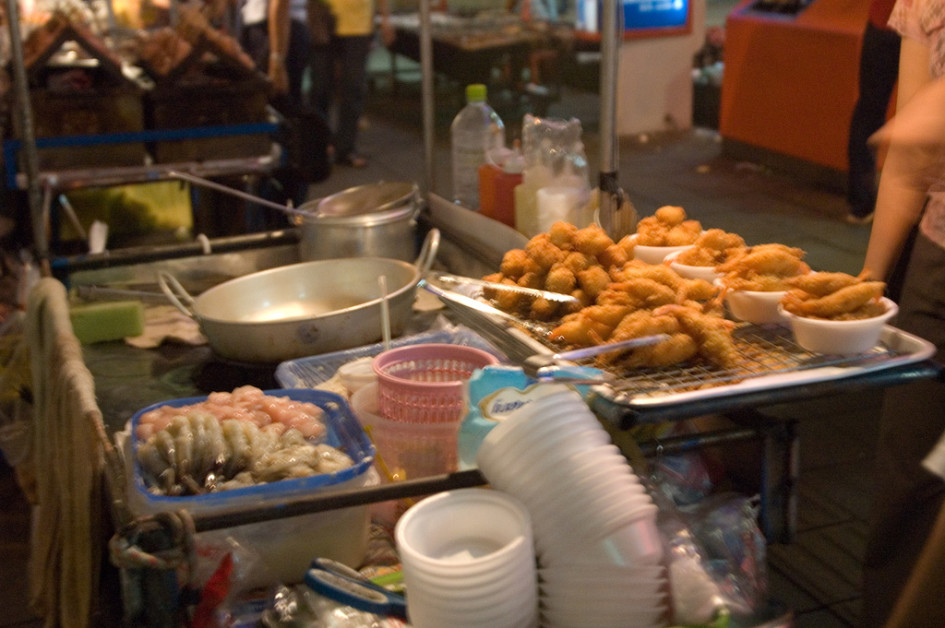
Looking for the best som tam and pad thai the street stalls of Thailand have to offer? Ask a local. Poll the front desk staff at your hotel in Bangkok for their favorite place to munch on street food. Let them know you’re not looking for an official recommendation so much as a friendly one, for the places where you might run into them snacking on a night off. Establishments frequented by locals are likely to be appetizing, affordable and authentic. They’re also time-tested and likely to be safe, helping you keep stomach bugs at bay.

Make Eating Elementary

It’s time to use your powers of deduction, Mr. Holmes. Scope out clues to find the tastiest, safest culinary delights. Is the place bustling with locals, or empty and quiet? Do the customers include women and children, or does it look like a boy’s club? Steer towards busy family establishments for the best chances at a clean, wholesome delicious meal. Elementary, my dear Watson. Delectably elementary.

Home Cooking = Food + Love

At Casa com Varanda in Rio de Janeiro, host Delvina serves up breakfast every morning. Doesn’t that sound better than anything that might come out of a faceless restaurant kitchen? After all, nothing is more nourishing than a home-cooked meal. Staying in a small, independent accommodation, such as a bed and breakfast, is a great opportunity to try authentically prepared, home-cooked food. Because these meals are generally prepared in small batches with love and care, they’ll be memorable for only the right reasons.

Expect the Best, Prepare for the Worst

No matter how careful you are, there’s no 100% proven method to prevent an upset stomach. Sometimes even the most upscale restaurants can leave you queasy the next morning. There’s freedom in this realization, however. If even the safest-seeming foods have the potential for tummy turmoil, there’s no reason not to go bold. Boarding a plane for Argentina? Throw some probiotics and anti-diarrheal medicines in your bag and book a stellar Buenos Aires hotel where you’ll be comfortable no matter what happens. After that, there’s no stopping you.

Street smart and prepared for anything, you’re ready to take on the world in all its flavorful goodness. From tamales in Cancun to Çiğ köfte in Istanbul, there’s a whole world of tastes to discover. Let the eating adventures begin!

The Most Expensive Place to Travel to See a Game in the NFL: Part II, The AFC

This post was posted by the chipmunk on Chipmunk’s Tailwind Blog on November 5, 2015.

football-2

If you’re a football fan living in New England, times are good.

For 11 of the past 12 seasons, the Patriots have dominated the AFC Eastern division and vied as a contender in the playoffs. Fresh off of last year’s Super Bowl XXXVIII victory, they’re off to a dominant 6-0 start in 2015.

But this success comes with a dark side: it’s incredibly difficult to get a ticket to a home game!

For the truly committed fan, however, there is a simple hack you can employ to see your favorite team play: travel to an away game. While doing this is generally pretty pricey (the average flight/hotel/game ticket total falls between $400-$900), some teams are more affordable to see on the road than others.

Previously, we took at look at how much it costs to attend various NFC away games; here, we’ll focus on the AFC.

As a refresher, in our prior post, we used our data to calculate the cost of seeing your favorite NFL team on the road.

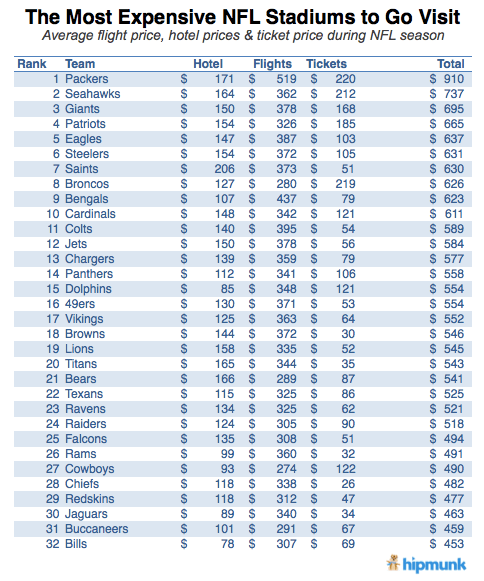
Our analysis included three cost factors: 1) The cost of hotels near a given NFL stadium for a night during football season; 2) The average cost of flying into the major airports closest to NFL stadiums during football season; and 3) The cost of getting a last-minute game ticket.

Using this data, we ranked all NFL teams from most to least expensive to see on the road. Far and away, the priciest place to see a game was Green Bay, Wisconsin, where a very good team and a huge fan base boosts not only ticket prices, but the cost of airfare and hotels during home game weeks.

2

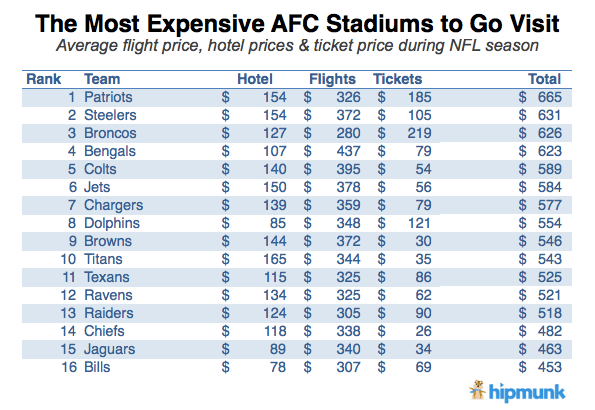
On this list, the New England Patriots’ Gillette Stadium in Foxborough, MA, is the most expensive place to visit in the AFC. Diving a little deeper into AFC teams only, let’s take a look at how they stack up against each other.

3

The Pittsburgh Steelers and Denver Broncos, both perennial football powers, round out the top 3 most expensive places to see a road game in the AFC. While the Steelers have surprisingly affordable tickets ($105, compared to the Patriots’ $185 and Broncos’ $219), the average flight into the city is among the list’s most expensive. The Broncos, on the other hand, have the most expensive tickets on the list, yet the cheapest average hotels.

If you’re looking for the best deal on any AFC game, the Buffalo Bills are your best bet. With hotels averaging only $78 per night and tickets priced around $69, a trip to Ralph Wilson Stadium runs roughly $453 — more than $200 cheaper than seeing the Patriots.

So, what about your team in particular?

Below, we put together a table of remaining road games for every AFC team, along with the total estimated cost to attend each game. Games that are expensive (top 20% percentile) are in red, games that are relatively cheap (bottom 30%) are in green, and those that are “medium-affordable” (middle 50%) are in yellow:

4

So, if you’re “cursed” by rooting for a team that is so successful it’s impossible to get a home ticket (we’re looking at you, Patriots fans), maybe you should try the road. Of course, if your team is doing really well right now, these prices could significantly escalate as the playoff race heats up. If you plan on taking a trip, it’s probably best to lock in your flights, hotels, and game tickets sooner rather than later.

Methodology: Hipmunk analyzed average nightly hotel prices at each stadium city location and average round trip airfare to nearest stadium airport during football season. Ticket prices were determined by analyzing the average prices of remaining away games starting in November, as provided by TiqIQ. Note that prices change daily depending on available inventory and in no way does Hipmunk guarantee the prices listed